|
The recognition that sanitary collection and
disposal of domestic waste must be considered a necessity,
bringing with it, the need for systems which could adequately
and proficiently carry waste for treatment. This resulted
in an underground network of collection lines resembling a
large stream fed by many tributaries. The same basic waste
transporting system prevailed right up to the present....
it is in this manner that the underground arteries of each
community feed the main influent line to the sewage treatment
plant. As communities continue to grow, new develpoments and
new industries are, in many cases, forced to utilize undeveloped
areas in relativly low elevation regions. In order to maintain
a workable network of underground collection lines, the system
must be supplemented by so called sewage lift stations located
a strategic points.
The true hurdles to be overcome with this problem have become
clearly defined only in actual application. In the case of
the sewage lift station, this hurdle can be summed up in one
word - solids! There have been numerous approaches to a solution,
but in practically every case either the installation or the
pumping mechanism requires an undue amount of care and maintenance
to prevent clogging or breakdowns. The first consideration
must be the elimination of the bar screen, which has its proper
place in the sewage treatment plant... thus eliminating the
need for cleaning screens, and the disposing of such screenings.
Secondly, with the bar screen eliminated, the pumping mechanism
must accommodate the free passage of any solids that flow
through the infulent pipeline, fittings and valves. The unit
muprovide a positive, non-clogging discharge action that will
efficiently move any solids entering the station. Fourth,
the installation should provide clean and sanitary operation...
eliminating undesirable wet well conditions, and permitting
easy inspection or maintenance checks without exposure to
sewage.
As a safety precaution and from an asthetic viewpoint, the
fifth concideration must be a hermetically sealed design that
prevents the escape of toxic or combustable gases, as well
as nuisance odors.
Finally, the mechanism should possess a resonably flexible
capacity to accommodate variations in flow... including the
ability to deliver at somewhat higher than rated capacity
during periods of unusual peak loads.
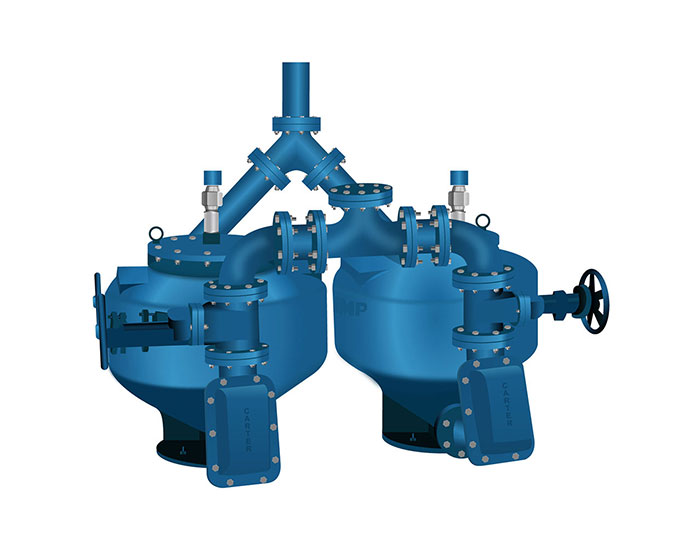
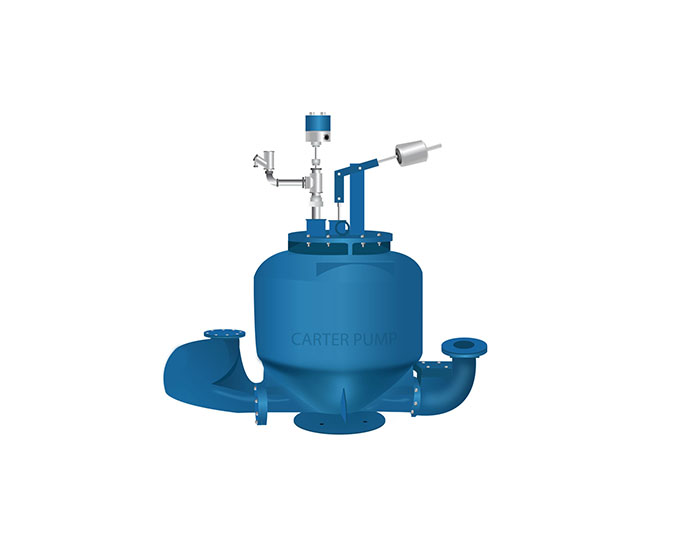
What is a Pneumatic Ejector?
The pnuematic ejector is a extremly simple yet reliable mechanism.
Fundamentally, it consists of a receiver or "pot' that
allows liquids and solids to enter without restriction. When
the pot becomes filled, compressed air is introduced to displace
the contents up to a higher discharge line. The Pneumatic
Ejector is unique as a pumping mechanism because no mechanical
parts are involved in the actual pumping of the material...
and it has no practical limitations on head. Under normal
flow conditions, the equipment is designed to operate with
a one minute cycle. The cycle consists of two phases. Filling
the pot, and then the discharging of its contents. Operation
is fully automatic with a choice of electric or mechancial
control systems.
You can now use the Carter Plunger
Pump Selection System to assit you in your search for
the pump which fits your specific needs.
|